


I seem to have lost Girl Power Claire somewhere along the way about six months ago, and I've been struggling to find her ever since.
To be fair, I have had quite a lot to deal with these past few months. You would think that after having pulled myself up by the roots to move to an entirely new country, everything else would be a piece of cake... NOT! I don't know, maybe the pressure of a new job just doesn't agree with me. Maybe I'm just not very good at dealing with change.
Or maybe, deep down inside, I am really just a Type B kind of person playing at being a Type A lunatic.
It doesn't help that at this point, I'm still so muddled about what it is that I really want. It's hard to motivate yourself to a course of action when you're not very clear on what your motives are.
What the heck am I doing here and what am I doing it for?
I feel bad about whining when in reality I am pretty lucky to be where I am... but sometimes, being lucky is relative. All I know is that these days, it seems that all there is is rain... and it's pouring pretty darn hard.
Okay, rant over.
*sigh*
Click here to read the rest of this post.
Monday, May 10, 2010
When It Rains...


Thursday, April 15, 2010
How the Heck Did I Get Back Here?

It's been more than two years since I decided to get off the medical training rat race for the sake of my own sanity. So what the hell have I done by hurtling myself back into the lunacy that I wisely left behind?
It's been three months since I took the plunge back into the world of acute tertiary hospital medicine. It only took two days into the job to realize that I was back in the same situation that I had flown thousands of miles across the ocean to escape. Only this time, I was starting from scratch in an unfamiliar environment, a completely different system, and completely and utterly alone.
Okay, okay... maybe all the stress has made me prone to exaggeration. After all, I have been working in the Australian health system for more than a year now - albeit in a small, laid-back, and friendly secondary hospital in the capacity of someone just one notch above internship. And I have been lucky enough to make my move up to registrar level in a tertiary hospital that is larger and busier but still small enough to be, in theory, less overwhelming.
But let's be honest here - there is no such thing as "less overwhelming." When you're overwhelmed, you're overwhelmed.
It's hard not to feel like you're drowning when you hear a Code Blue announced through the paging system and have no idea where the heck it is. Or when your page refuses to stop beeping while you're in the middle of figuring out what to do with the latest patient you've been asked to admit. Or when a nurse is reaming you out for not having "a proper plan" for a patient who you haven't even seen yet.
And that was just on my second day.
It's been tough going these past three months. And it's also been all too easy to morph back into the high-strung, maladjusted stress ball that I'd always been. The one whose start of the work day is heralded by palpitations and capped by tension headaches. The one who suddenly wakes up at 4 in the morning and is unable to go back to sleep because all of her patients and their problems are running through her head. That stress ball.
I'm coming to the conclusion that maybe I'm just not cut out for the responsibility of being in the driver's seat. Or maybe practicing medical training is bad for my mental health. Which leaves me in a huge dilemma: because medicine is the one profession where: a)one is absolutely not allowed to stop learning and growing, and b) you can't get any more full on in the responsibility department than dealing with life and death.
Is too late for me to try my hand at becoming a lounge singer instead?
Click here to read the rest of this post.
Tuesday, December 29, 2009
One Third
I look back on the decade that is just about to pass and have found that my life these past ten years has been defined by one major thing: Medicine.
Considering that 10 years is roughly one third of my current lifetime, that's a heck of a long time.
Unlike other med people - probably more well adjusted than I was - entering medicine was like going into a state of suspended animation, a kind of extended adolescence. Life and the world marched inexorably on as I was immersed in an educational system that looked more like high school than it did university - same classmates in one huge lecture hall within a small campus, volumes of books to read, endless exams, day in and day out.
My world, not already incredibly big to begin with, grew ever smaller - maybe partly by necessity, but defintely because of circumstance.
It didn't change much with the transition to hospital life. 24 hour duties, 36 hour days being flat out with patient care on top of the academic load didn't really leave me much time or energy to spare. Add to that the fact that most of my friends were from this little world as well, and there really wasn't much impetus to see what else was beyond it.
For me, staying focused on the end-goal was also defending my sanity - something that kept me from questioning why the hell I was doing what I was doing. Which is probably why I railroaded myself straight into residency, 3 more years of same as the above.
It's no wonder that I was a certified basket case at the end of it. MD and Diplomate cerificates in hand, to be sure, but a basket case nonetheless, scratching her head in bewilderment at where all the years had gone and wondering if she even ever wanted what she got.
I decided two years ago to break the pattern, do the unexpected, and get the hell out. In a manner of speaking. Which has brought me here.
I've spent the last two years of the decade out in the real world, but with one foot still inside the door of medical life. Oddly enough, I must admit to feeling a little lost now that my work has stopped being the defining force in my life, but it has been a good time. I still haven't quite figured out if I want what I've gotten or if I really want to go where I'm going but I've found that I can ease up on the quest a little, enjoy the slower and meandering pace, and still keep my sanity.
All that being said, guess what? I'm going back to training next year. It will be, basically, starting from scratch. As if ten years weren't enough.
Crazy, I know. I guess there's a very real, very influential masochist living inside my head. I'm doing it partly because I don't see any real reason not to and partly because it's the only logical way I can actually stay here for the meantime. I'm still not sure what I real end goal is... but hopefully, it won't take me another ten years to figure things out.
Wish me luck.
Click here to read the rest of this post.
Wednesday, March 11, 2009
Welcome to the Real World

To the new set of Clinician Wanna-Bes:
You've probably been waiting on this day for years. Some of you from the day you started medical school; most of you for even longer than that, from the moment you made that firm decision to become a doctor.
After years of hard studying, sleepless nights, and sacrifice, you finally have that crisp diploma in your hand, the hood symbolizing your new status pinned on your toga. Now you can choose to slip on that coveted white coat and apply what you've studied by beginning your practice as you've dreamed of doing.
Congratulations. You've made it through the easiest part of your journey. Welcome to the real world - where the worst is still to come.
Reality is that despite all your exposure and experience as a student, being a doctor is nothing like being in medical school. You will never really know what it is like to be a doctor until you have a patient who is entirely in your hands.
All at once, all the things you thought you knew recedes into the background and everything you know you don't know suddenly takes up center stage. Faced with a patient who hangs on your every word and takes everything you say as gospel just because you're finally wearing that white coat, all five years of learning the science of medicine is negated by everything you didn't learn about the practice of it. And when you need the most to deliver, you are appalled by the thought that 80% of the time, you're bluffing your way through it and praying with all your might that what you did, what you thought, what you said was right.
Reality is that we all have to start out this way... because medicine is about practice and experience, and that the mistakes we make with our patients along the way ensures that we'll be able to make a difference in more patients' lives in the future. Be encouraged by the thought that even the consultants we admire the most or are most impressed with started out exactly the same way.
The more patients you handle, the better you get - at learning, at practicing... and yes, even at bluffing. But despite the growth in your confidence and skill, that staggering terror at the weight of responsibility will never completely go away. Which is a good thing because no matter what we are doing or where we are practicing, it will keep us on our toes. It will drive us to keep our edge, to stay updated, to keep on learning.
You will not always be a young doctor. And doctors only get better with time. But you will have moments - many of them - when you will wonder if your heart can endure the seasoning it will take to become a good doctor... or even if that is what you want to become in the long run. There will be many heartbreaks along the way and your heart will sustain many scars before you are through. And reality is the process of becoming never really ends. It's a lifelong process.
But as real as the challenges are, the joys of practice are also there to be mined to the fullest as well. So take heart and know that it is actually in this real world of medical practice that the best is also always still to come.
Good luck and enjoy the journey!
A contribution to Gigi's TBR at hosted at The Last Song Syndrome - A Letter to the New Medical Graduates
Click here to read the rest of this post.
Tuesday, March 10, 2009
Nine Months
 me, trying to bring home an image of Bunker Bay (Dunsborough, WA)
It's hard to believe nine months have passed since I began my "great adventure." Nine months since I'd packed my bags and come to this city I'd never seen with nothing but 2 suitcases and the clothes on my back, armed with nothing but the vague hope that doing this "one brave thing" would open up my life. Nine months into the year I said I'd give myself to breathe.
Time has certainly flown - and, to a great extent, I along with it.
In these past nine months, I've fallen in love with this city on the water, with its slow pace, easy rhythms, and stunning beauty. I've learned to appreciate the value of being on my own and, conversely, to open my heart to precious friends that would once have been so "other" to me. More importantly, I've learned to revel in the gift of this solitude, and to be more forgiving and loving to the "me" that's slowly emerging from her long time hiding place.
Nine months later and I can't believe how far away I am from the straight and narrow road I'd complained about walking on all my life. I've never been more aimless, yet I also don't remember ever feeling as free.
On the other hand, I'm no closer to a definite long term plan now than I was nine months ago. I may have signed on for another two years with my current job, but I'm still thinking in terms of living from the next few months to the next.
I know I have to start sorting out my life, to get into a training track while the opportunities are there. While I love my life here in Perth and cannot imagine leaving, I also know that it's time I started exploring my options. I know I have it in me to start over once more in another hospital, even another city, if that's where the opportunities are - I know because I've done it once.
So, no, I'm not yet up to making plans. But I am open to more possibilities - wherever they may lead me. Who knows where I'll be even just another nine months from now? The thought terrifies me, but it's heartening to realize that no matter where I'll be, I know I can handle it.
Click here to read the rest of this post.
Monday, January 12, 2009
Strange Things I Know to Be True
One of my patients passed away at work today.
As a doctor, even one who has only been in the practice of medicine for going on a decade (including medical school), I'm definitely no stranger to death anymore. But the circumstances around his passing reminded me of a few strange but common occurrences related to dying that I've witnessed over the years.
Here's the story: my patient was an 85 year old, slightly demented and not for resuscitation, who had recently had a heart attack. He had been doing poorly for a few days, but seemed to be turning the corner clinically.
But by way of most cardiac patients, after having a restful night, he suddenly just stopped breathing and had no audible heart rate - his heart probably went into an arrhythmia. While we were placing the cardiac monitor leads on him, he spontaneously started breathing again. Given the length of time he was out, we figured he wouldn't wake up. We told his niece to let his family know that the prognosis wasn't good, and she had already phoned most of his relatives, who would be coming in shortly.
The staff and I left the room to give his family private time and so I could update my consultant about what was going on. When my consultant came a few minutes later, we came into his room and saw that while he was awake, we all got the feeling that he would not last long. Sure enough, he passed on within the next two hours - after all of his relatives in the area had come in to see him and say goodbye.
Which leads me to the first strange thing I know to be true: dying people can actually "hold on" in order to wait for certain people who they want to see before they die.
One more strange thing I know to be true - very sick patients, most often the terminal ones, have a final surge of strength or a "good day" shortly before they slip away. Sometimes we get lulled into thinking that these patients are clinically improving, only to be stunned the next morning to find out that they've passed on in the night.
It is also possible to die of a broken heart. And I don't mean that in a physiologic sense. Have you ever tried looking at old gravestones and noted how close apart old couples die one after another? It's probably because after one passes, the one left behind loses the will to live. I had a 80 year old patient recently who was quite well medically and good functionally until his wife died. After that, he was in an out of hospital, and he died of pneumonia six months after she did despite all our medical efforts. Quite simply, he had lost the will to live.
Non-medical people will find the concept difficult to understand, but health professionals - doctors, nurses, carers - can actually spot when a patient is on his or her way out. It comes from experience, of course, but we can tell. But one more weird thing my co-residents and I have noticed in our dying but awake patients - when they ask for water, death always comes close behind. Seriously. I don't know how true that is in other medical people's experience, but it's certainly been true to my and my co-residents' experience.
And you know the one about the dying calling out for people who have died or saying that they see people who have died calling for them? That one happens pretty often, too.
Sorry for the morbid turn. It's just amazing to be reminded that there are so many things that can't really be explained by logic or science but actually occur in the world.
Do any of the other medical people in the house have any other weird observations and anecdotes to add? Oh, there's still that one about what happens to people (specially psych patients) when it's a full moon... but that's another story.
Click here to read the rest of this post.
Saturday, October 11, 2008
The Power to Choose
 photo found via google. i don't know who took it, sorry!
I am a Christian. I have been raised and educated as a devout Catholic and am fairly active in my church. But I am also a doctor, and this is one issue where my personal beliefs and dogma and I do not see eye to eye.
And I agree that it's past time that a Reproductive Health Bill in the Philippines was passed - and executed.
It's a delayed reaction to a fairly dated issue, but I felt so strongly about the topic that I couldn't resist.
I am pro-choice but I do not believe in induced abortions. This is something that I, as a doctor, would never do for any patient. But what I don't understand is the mass hysteria being drummed up by about the issue of artificial means of contraception.
Just reading the statistics alone is already quite convincing. The Philippines is among #15 in Asia with the highest maternal mortality rates - the top causes of which are hemorrhage and abortion, of which a significant number are induced. Many of these deaths are preventable - by adequate nutrition, proper spacing between pregnancies, and, yes, even limiting family size.
How is teaching the largely ignorant populace about responsible parenthood and providing them with means to practice it an affront to the dignity of life? How does seeing the logic behind a smaller family size and wanting to prevent unplanned pregnancies make those of us who are for this bill akin to murderers?
There are those who feel that sex education, education about artificial contraceptive methods, and providing free access to artificial contraceptives somehow encourages a culture of promiscuity. Frankly, I think this argument is flawed on several levels, not the least of which is that it seriously undermines the people that they are seeking to protect. Besides this, the reality is that, despite our largely conservative-leaning society, increasing sexual activity among the young and unmarried is actually quite prevalent and has been for some time. Turning a blind eye to this reality and sticking our head in the sand will not make it go away.
I think, that for me as a doctor, the most convincing argument for family planning, responsible parenthood, and sex education was working in the OB Admitting Section every three days for several weeks as a medical student, then as an intern.
The concept of a woman having more than 3 kids for me simply boggles the mind, but there I saw countless grand multiparas (women who have given birth more than 5 times) reaching their status before the age of 30, already on baby number 6 or 7. I'd had to assist at emergency hysterectomies for these women with overused uteruses that refused to contract after delivery, causing them to bleed and bleed and threatening to leave their many children motherless.
On the other end of the spectrum were the young primis - the youngest in my experience was 14, just in her first year of high school, who never had a single pre-natal consult prior to delivery. I can't imagine what kind of parenting these young girls can offer their babies, not when they were hardly out of childhood themselves and were now forced to grow up much too soon.
And then there were the women who came in for induced abortions that were not completed, septic, bleeding, and often on the brink of death. It was both fascinating and appalling how creative and innovative some of these very desperate women would be in trying to terminate their unwanted pregnancies, turning to methods ranging from the sedate to the bizarre. Some are lucky enough to make it through. Some are not.
Do I believe passing the Reproductive Health Act will change the stories of the women who I've talked about above? Maybe, maybe not. But let's not lose sight of the fact that in the end, no one but the couples themselves can dictate what they do in their bedroom, in their sex life, and in their family lives. No one can argue with that. Isn't it then only right that they are given the chance to make informed choices?
Click here to read the rest of this post.
Wednesday, October 01, 2008
Channeling Sporty Spice
 my battered 3 year old rubber shoes - whose soles have been recently glued back on as a stop-gap measure. I need new ones!
My relationship with fitness has always been erratic to say the least.
Maybe it was my debilitating self-consciousness and fear that I'd end up making my team lose the game (which happened enough times in my budding career as a PE dunce for my fear to have a basis), maybe it was just my general aversion to anything that would make me sweat, or maybe it was my resigned acceptance that I have always been and ever will be "nerd" with mental calisthenics as my forte. But having learned from my elementary physical education classes that I had the athletic ability of a plant, I've never been particularly enthusiastic about any sport I actually had to participate in.
Of course as I grew up, my teenage vanity and my parents' constant prodding made it imperative I get off my butt and get fit. Exercise became a means to an end - losing weight and looking great. Always existing in my life alongside the latest fad diet, exercising would get me results but I would feel absolutely miserable and tired all the time. I mean, who would be happy subsisting on only an apple for breakfast, an egg for lunch, and nothing for dinner for every day activities, not to mention adding an hour-long aerobic session daily on top of it?
Needless to say I wasn't able to sustain that particular diet and weight loss program for very long.
The funny thing about me is that when I am into the whole fitness thing, I am really into it. Seriously into it. I've been through a biking phase, walking phase, a tae-bo phase, a regular gym rat phase, even a very short yoga and swimming phase. (All nice, individual activities - I never got over the trauma of being the team goat.) But once I stopped, inertia would often hit - and it often took serious shake-ups to motivate me to get going again.
Apparently moving to another country falls under the category of a major shake-up - because for the nth time in my life, I am once more channeling Sporty Spice.
Getting back into the active swing of things began as something of a necessity. My lack of wheels initially forced me to walk anywhere and everywhere, and I rediscovered the benefits of having an endorphin high.
After a few weeks of maximizing my on-foot exploration, I realized I had enough time on my hands to make a serious bid for fitness once more - and signed up with a local health club. I do time on the elliptical, the treadmill, and the rowing machine, life weights, and attend the yoga classes. The endorphin high is amazing, and great antidote to on-the-job-stress and on-my-own loneliness. To mix it up, I've kept my fitness walking for weekends when I feel like wandering - and there are just so many beautiful spots here in Perth for walking or jogging that's just a train ride away.
I'm really buying into the sporty, outdoor lifestyle of Perth. I can't imagine feeling this enthusiastic about walking or running in Manila, that's for sure - I happen to have an aversion to inhaling gasoline fumes. I'm even thinking of getting my first grown up bike - never mind if I haven't gotten on one since college. And I am even flirting around with the possibility of training for a 10K run in April, something that I've never ever done before.
Every time I get started on a fitness craze, I always swear that I'm going to stick to it this time around. After all, being a doctor, you would think I'd know enough about the benefits of exercise to keep me motivated, specially given all my personal risk factors and the fact that I am not getting any younger. But I know from falling off the wagon so many times over the years just how hard it is to keep a fitness program up - often because life gets in the way and it just becomes less of a priority. But I am hoping that this is the time when the fitness crazy part of me really sticks for good.
I'm just glad that my schedule here allows me this great form of "me time" - and that Perth is just so conducive to a healthy, active lifestyle. I may have the athletic ability of a plant, but what I seriously lack in ability I make up for in enthusiasm. With the weather warming up, I am looking forward to more outdoor fitness activities in the spring sunshine.
Click here to read the rest of this post.
Monday, September 29, 2008
Managing Older
 photo from flickr
This is something that, as a doctor, is quite new to me, coming from a country where the life expectancy at birth is easily a decade below Australia's and most of our patients are lucky to get any medical treatment at all. Dealing with such an elderly population has been a learning experience in itself, but it has its own share of difficulties and heartbreaks.
Aging inevitably takes its toll on the human body, no matter how well one lives, so it's not surprising that most of our elderly patients have multiple medical problems. While there are also a number of elderly patients who have reached their grand old age with few serious co-morbidities, arthritic pain and reduced mobility is a common problem many share. A good number of them have been living in late-stages or even end-stages of many chronic illnesses for a number of years, the natural course of their diseases staved off by the good health and community support they are given by the system.
I had never seen many patients with dementia - until I came here, where many of my very old patients have it one form or the other. It's profoundly sad seeing someone struggling to hold on to the bits of pieces of themselves and failing. In the span of my three months here, I have seen many people falling into the entire spectrum - from those who are just beginning to gradually slide into short-term memory loss to those who have to be placed in higher level care because they would be otherwise a danger unto themselves. As heartbreaking as it is to watch as an outsider, I can only imagine how it must be for the patients' families and caregivers.
Strange as it may sound coming from a doctor and someone in the general business of prolonging life, dealing with older patients has made me realize one thing: I do not want to live to grow that old. Friends and I often morbidly joke that the best way to go is by sudden cardiac death after you've been old enough to enjoy life and a bit of your retirement - you won't even know what hit you.
Don't get me wrong, I don't mean any disrespect. I do want to live a long and active life, and I hope to be healthy for the most of it. But I don't want to live long enough to feel my knees, hips, and back start to go even with the aid of modern surgery; don't want to live long enough to lose control over my bodily functions; don't want to live at all if living means losing myself mentally little by little. I admit that this mind-set and very personal preference sometimes makes me wonder if maybe some of the patients who we treat full-on feel the same way.
Having come from a system where financial constraints often dictated the extent of what could be done for our patients and the choices were often limited and thus more clear cut, working here has been different kind of challenge. In this health care system where in medical care the sky is the limit, doctors treating these kinds of patients are faced with many difficult questions.
Issues like pre-morbid quality of life and projected quality of life after admission are no longer trivial questions asked for mere completion of a patient's personal and social history but very important pieces of information that are core to the medical team's approach to management.
I've heard it said often that one of the hardest lessons a doctor must learn in his lifetime of practice is knowing when it is best to fight harder and when it is kinder to let go. In this environment of relative abundance in medical technology and resources, I think that maybe it becomes even more challenging lesson to learn. Click here to read the rest of this post.
Friday, July 18, 2008
Nosebleeding in English

Yes, I have been raised bilingual. Yes, I have been instructed in English since I've been old enough to read. Yes, I have used it in academic discussion for just as long and everyday conversation for even longer. And, yes, I probably read and write better with it, maybe even express myself with it, than I do with my native tongue - and I have a body of work, a thriving blog, and academic IELTS scores to prove it.
But my first month abroad is quickly teaching me that despite my background, I am, as someone who uses English as a second language in an English-speaking land, still prone to frequent "nosebleed*" moments.
Despite having fair command language, I often find myself suddenly bereft of words to express certain thoughts or questions quite unexpectedly. I find myself stopping at mid-sentence when I would frantically grab for an English word in my otherwise good vocabulary only to find Filipino words floating to the surface instead. At times, when my mouth is running faster than my brain, the occasional Tagalog integrates itself into my stream of thought, only to be met by puzzled glances.
In fairness to me, I've been complimented quite often at how fluent I am in English relative to how long I've actually been living here. My English has been good enough to get me through the basics of day-to-day interaction - asking for directions, following instructions, striking up conversations with complete strangers at bus stops (yes, this actually happens quite often in Australia). This country has become such a multi-cultural place that Aussies take my occasional grammar and pronunciation flubs in stride - and are often way more forgiving than many people are back home would be if they heard me.
But the biggest adjustment so far has been in my interaction with the patients I see at work - something other overseas-trained doctors who work in English-speaking countries probably grapple with as well. Although I was taught medicine in English and my conceptual understanding of medical knowledge is in English, I have gotten used to conducting interviews and asking questions in a way that would be better understood by the patients I used to see back home. All of a sudden the metaphors and the analogies that have served me well for so long no longer work. Explanations of common conditions I've used for years quite effectively must now be reworked for my English-speaking audience. New subtleties and nuances have to be relearned.
I don't think that makes me a worse doctor than I used to be. It just means that, for now, I have to make more of an effort to be understood and to understand. Knowing that I have to keep on my toes works in my favor, and it's that effort that I put in that closes the gap. It's slow going, but I like to believe I'm getting there and getting better every day I come into work, every patient that I interview. It's all just part of the growing pains of practicing medicine in a foreign country.
Nonetheless, no matter how fluent I get at speaking English, I know the nosebleed moments will probably remain a fact of life. And while I may have no real, formal knowledge of Filipino and my actual Tagalog vocabulary is shallow at best, not speaking it for long spells has made me realize that a heart-deep connection with it exists - and I miss using it, in a major way.
(*For people not in the know, the term "nosebleed" is Filipino slang for something exceedingly difficult or takes so much effort that it makes your nose bleed. It is often used in the context of someone trying to conduct a conversation in straight English and struggling mightily with it. I don't know how widespread the term's use it and how accepted is the term's use is in this context - so please free to correct me by posting a comment if I am wrong. :))
Click here to read the rest of this post.
Tuesday, July 15, 2008
Walking the WOC
See one, do one, teach one.
There is only so much medical knowledge that you can glean from reading the books. An internist's clinical eye can only be developed by actually seeing. A surgeon's hands can only gain their skill by actually doing.
And for doctors just at the beginning of our journey, the quality of practical knowledge often rests on the guidance of our teachers' wisdom and expertise. Our mentors spend time every week to see our patients with us, and share valuable clinical pearls with us - and many of them WOC - without compensation.
Having worked only in a training hospital and been reared in a culture where teaching is the norm all my years as a doctor, I admit that I never fully appreciated the time and the effort that our consultants put into our rearing.
It boggles the mind how these doctors, now leaders in their fields with busy practices, give precious hours of their time to teach despite the lack of financial return. How surgeons who charge a hefty fee for each procedure serve as first assists to surgical trainees doing a complicated procedure for the first time - and do it for free.
What's in it for them? Cynics will say that the prestige of being associated with a university with such a well-established reputation is motivation enough - but given how easy it is to get the hospital tagged to your name without having to give anything back, it cannot be the explanation. Maybe there are just people who simply love to teach. And then there are those who believe in paying it forward.
Whatever their reasons, these teachers continue to inspire and spur on struggling trainees to reach the standards they have set. And in doing so, they pass on their love of medicine and of teaching, so that despite the many challenges of a medical career, there will always be those who will walk the WOC with them.
* * * *
This is a contribution to The Blog Rounds 16 - Unsung Heroes hosted by Doc Gigi.
Click here to read the rest of this post.
Wednesday, July 09, 2008
Lucky Country
 the healing hands fountain in front of the hospital where i work
 I've been working here just a over week, and I still can't get over how lucky "public" patients here are. I know that all medical systems have their flaws, and Australia is no exception, but compared to back home, they don't know just how fortunate they really are.
I work in a public hospital (government funded) in one of Perth's outer suburbs, a fairly small one relative to my old medical home. It's a 200 bed hospital that's just inching its way towards secondary hospital status - by Australian standards that is. We don't have an ICU and as a rule (strictly enforced) we cannot have intubated patients or toxic patients here. We don't have complete specialist cover and have to refer some of our patients to the bigger centers in Perth who need consults.
Despite this, in this little hospital, we have access to diagnostics and resources that my fellow co-residents and I would have killed for. All you have to do is order them, arrange for a schedule, and most of the time you get results within 24 to 48 hours. For blood work, you can get them as fast as half an hour. I know this must sound routine to someone who works in a first-world insititution or even a private hospital back home, but for us, it was all but a wistful dream. To top it off, puiblic patients don't have to pay a single cent.
And the drugs! All you have to do is write it in the chart, and it's all provided for. Antibiotics are given regularly, without fail. No need to run around looking for donors, worrying about where you are going to find your patient's next dose. And this covers discharge prescriptions as well. No need to wrack your brain cells and make up unconventional combinations looking for the cheapest option.
I'm often given amused smiles by my fellow residents when I'd give a delighted, "Oh, you have that (can do that/can give that) here? Wow! I've never seen that done (given to a patient) before!" Believe me, I've said it so often, it's become almost embarrassing.
On the other hand, they can't wrap their head around the idea of relatives who ambu-bag patients who cannot afford a mechanical ventilators, let alone patients who ambu-bag themselves. The concept of young patients dying simply because there are no medications to be had is unthinkable to them. And treating empirically based on a clinical diagnosis is almost akin to a joke. Yet these are realities that I and fellow doctors who work in government hospitals in the Philippines lived with every single day.
Being exposed to all this excess, I can't help but being a great deal envious in behalf of the many needy patients back home. And sad, because given the place health is given in our national budget, to have something like this back home is something of a pipe dream. As it is, the government cannot even pay trainee doctors a decent wage for service hours rendered; it is never going to have enough to cover the health expenses of even just the Filipinos who find their way into the hospitals across the country. The ever-upward spiraling prices of health care in the world makes the unlikely almost impossible.
Whenever I hear someone here griping about how lousy their health care system is, I'm always tempted to make the retort, "How about I send you to the Philippines in place of one of the patients we have in the wards?" Just a day in, and I'm sure they'll realize what we all know to be true - they're still pretty damn lucky.
Click here to read the rest of this post.
Monday, July 07, 2008
Blue Monday
 those i'm friend-sick for
People warned me it would catch me unawares. And just like that, it did.
I've had a bad day at the hospital today. I can't go on a comfort shopping spree because there's nowhere open after five. I can't watch a movie because I don't have a car and it's not a great idea to commute at night. I can't even drown myself in ice cream because I missed the last open grocery - which closes at six.
But most of all, it's hit me that there is no one here I can just ask over to whine to... to have some retail therapy with (besides, the shops are all closed!) or have a soothing coffee with or get wasted with. No one to gripe with about the unfairness of life over lunch or dinner. No one to make unsubstantiated and totally unlikely scenarios of vindication with.
I've been in constant communication with my parents - and that had helped a lot - but there are many things about my job that my non-doctor parents will never understand, and bad days at work are among them. Besides, I'd never try to get wasted with my Mom - got to keep up appearances, after all.
My other workmates try to be supportive, but it's early days yet. Nowhere near "Let's-get-drunk-so-all-this-can-go-away" or the "let's-shop-and-comfort-ourselves-with-the-joys-of-materialism" just yet.
I miss my batchmates. And just like that, I suddenly miss home.
Click here to read the rest of this post.
Saturday, June 14, 2008
Mission Impossible
 This is not even half of it...
It was hard enough packing up three years of my life away in the callroom last December, when all I had to do was throw things in my car and drive them to storage at home.
So how does a sworn pack rat like me figure out what to bring abroad for a year and stay under 20 kilograms?
My friends have suggested not to buy too much and just buy in Aussie when I get there. Unfortunately, quality clothes and shoes are expensive over there; bargain clothes there are not as good as what I can get here for a lot less. So everything I'd saved up for the past few years not buying new apparel unless absolutely necessary, I've completely blown on the still-growing pile of shoes and clothes in my room that I am in total denial about.
Thankfully, I do get additional shipping freebies up to Melbourne of about 20 kgs, so I really have 40 kgs all in all. I will have to pay for the shipping from Melbourne to Perth, so that part must wait until I have cash to spare. Thus, smart packing is in order - and I have to be able to carry with me all my must-haves for at least two months in my suitcase.
Sounds easy? For normal people, maybe. For a perennially pack-heavy traveler pack rat? It's mission impossible.
As ever, procrastination and denial go hand in hand, and I have yet to sort everything out. Finally putting stuff in a suitcase and a box will finally make everything real - and I am really not ready for that yet. But with less than a week to go, I really should get started on this.
I have been living in a cloud of unreality these past three weeks, and the days have zoomed by without my looking. Don't get me wrong, I am going through with this. But to be honest, I still ask myself why I even want to sometimes.
Okay... time to make a checklist and get my ass in gear. It's packing time! To the seasoned and the experienced - tips will be greatly appreciated. I need all the help I can get!
Click here to read the rest of this post.
Wednesday, June 11, 2008
Disasters and Miracles

This past week has been a whirlwind of activity - what I get for being a pessimist and putting off everything that needed to be done until the very last minute. Exactly one week to my fly day, and there's still so much to be done. And that doesn't even include packing! Given this extreme spike in my stress level, my innate scatterbrain tendencies have been working overtime.
Because of this, last Friday, for about an hour, I thought that all of my plans had suddenly, irrevocably gone up in smoke.
Meet my purple expanding folder - which contains ALL my personal, ORIGINAL copies of my credentials and other documents essential to my pending trip.
Not being a complete dunce, I have already photocopied these same documents in a set to be left with my family in Manila, but since I am still in the process of compiling it, my photocopies are in this same envelope, too.
So in short, my whole life is in that envelope.
My disastrous story begins on Friday morning, when I left the house without bringing my cellular phone with me. Leaving my phone is usually not that a big deal for me, but since I had a lot of errands to run and needed a phone to coordinate with people I would be meeting, I asked my brother to meet me at the mall with it.
I had just come from the POEA, where I had spent the past few days fixing my exit clearance and registering as a bona fide OFW, so I had my precious envelope in tow. As I waited for my brother, I lugged it from one shop to the next as I tried on clothes and did some last minute shopping.
I hadn't been to this particular mall for years. Around a few minutes before I was to meet my brother, I saw that the store I set as a venue for us was no longer where it used to be. Worried we wouldn't find each other because of this, I went to the nearest pay phone and tried calling him - repeatedly because he wouldn't answer - and getting in touch with the house. Since it was difficult to hunt for coins in my black hole of a bag with my arms full of purchases and my bulky purple envelope, I put the envelope on top of the phone... and forgot about it.
Yes, I completely, utterly, stupidly forgot the envelope on top of a public phone in a mall. Someone give the idiot a prize!
After I met up with and got my cellphone from my brother, I promptly left the mall to run my other errands all over the metro, blissfully unaware that the key to my entire life was gone. Hours and kilometers passed. I guess I was so used to lugging it around with me that I assumed it was still with me all that time.
It was only at my last stop - the photocopying shop in UP Diliman - that I realized that things had gone horribly wrong. I felt like my entire world had completely disintegrated. It took all my willpower to hold on to sanity to drive through the rush hour traffic to get back to the mall. I was trying not to think about the fact that I would have to reconstruct a file of documents put together only after months of tedious legwork in TWO WEEKS. I was looking for an escape hatch from taking the trip, but this wasn't the way I wanted to bail out! At every stoplight, I was furiously texting all the praying people I knew in my phonebook, begging them to pray for a miracle.
My brother had gotten to the mall ahead of me, so I asked him to check the phone I used in the slim hope that it was still there. It wasn't. I told him to try the security office to see if anyone had turned it over. No one had. I told him to check the last places I recalled going to. No one remembered seeing anything.
It was around the time my brother told me there was nothing in the security office that my control started to slip. I was hysterically bawling as I was driving and praying incoherently - I was just saying please over and over again. When I finally got to the mall, I parked in the first slot I found and shot into the mall to retrace my steps one last time, but not with much hope.
As I was walking around the Food Court, on my way to the other set of public telephones I used, someone called me on my cellular phone. Apparently, she saw my home number on one of my documents and wanted to inform me that my envelope with the mall security in the area where I was, and the person who answered at home had given her my cellular number. She figured I would want to know ASAP that it had been found, even if I wouldn't be able to pick it up at once.
It turns out that a costumer had found the envelope earlier that afternoon and had turned it over to the food court security. They had waited for someone all afternoon to claim it, and, just around the time I was having my fit of hysterics, the manager finally decided to go through the papers inside it to see if there was any contact information they could use to get in touch with me.
Coincidence? Maybe. Me, I firmly believe it was the power of praying friends and God taking pity on His stupid, scatterbrained daughter.
In this time of great uncertainty and major life changes, God continues to remind me that He's on top of everything. And despite my frequent flirtation with the edge of disaster, He brings forth miracle after miracle - and I cannot thank Him enough.
Click here to read the rest of this post.
Wednesday, June 04, 2008
Hitting Panic
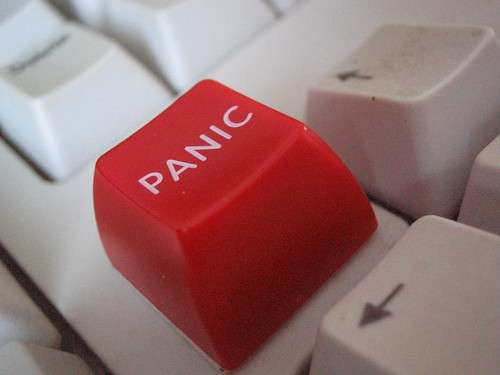 photo by Krysten
I already have a flight date, almost all of my papers are in, and it seems as if all systems are really go. I've completed most of my shopping, and I have enough time to finish sorting out my stuff before I leave if I start doing it now.
Everything seems to be almost ready but me.
Can someone tell me where the brakes are?
I thought I'd had ample time to get my head around the fact that I am going to be leaving my entire life behind to start anew in a city I have never been to, where I do not know a single soul, away from everything I know and everyone I love. But D-day is approaching so much faster than I thought it would.
The urge to cling to the familiar is overpoweringly strong. The excitement of a new adventure is tempered by a good dose of fear, guilt, and sadness at the thought of leaving my support system behind. As the days to my departure wind down from one to the next, I have to stop myself from frantically looking for an escape hatch.
Talk about being careful what you wish for!
My friends are more excited for me than I am at this point. I guess it's easier for them to keep my life in perspective - that this is only going to be for a year (at least for now), that I need this change and the experience will be good for me, and, if the worst happens, I can always come home. Their encouragement is my lifeline and one of the biggest reasons I haven't exercised my right to change my mind.
Frankly, I still have no idea what I am doing - and I think that's a pretty good excuse to give in to panic every now and then, don't you? But despite my panic, I'm seeing this through with faith that the courage to jump is a real prelude to learning how to fly.
Click here to read the rest of this post.
Friday, May 30, 2008
Off the Edge

This is how I feel at the moment.
The visa is in, and suddenly I am careening full speed ahead. While I know I have been planning this trip for months, I feel like I've been suddenly pushed off the edge. Probably because, given my penchant for pessimism, I haven't really given myself any leeway to get used to the idea that I'm leaving.
On the other hand, glitches just keep on coming - some of them due to my own stupidity and lack of foresight. I am still running against the deadline, and since the process of getting the visa took so darn long, my papers there are no longer valid and I have to send new copies. It's a tedious and frustrating process. This is particularly daunting because I have bled my savings dry and if things don't fall through, I will be all but destitute.
Oh, well... nothing to be done now but let what will happen, happen! After all, they don't call it a leap of faith for nothing. Click here to read the rest of this post.
Friday, May 09, 2008
Under the Influence
 my co-resident Jill during teaching rounds with her students
 Up to my 4th year of medical school, I was going to be a pediatrician after I graduated. Since I'd always enjoyed kids, I thought becoming a kid doctor would be a great way to spend the rest of my productive life.
Then I realized that liking children does not translate to liking treating sick children - it cut me up too much emotionally. Also that practicing pediatrics involved a lot of mathematics - medication doses, ET sizes, IV fluids were always based on weight - which I abhorred. Besides that, children and infants were notoriously difficult to line.
And, most importantly, I fell in love with Internal Medicine.
IM had always lurked in the periphery of my choices ever since we had our first lectures on it in 2nd year. As far as I was concerned, it was the subject that first introduced me to Real Medicine. The thought process of arriving at a diagnosis appealed to my inner nerd immensely. I enjoyed our 10 weeks of lectures in 3rd year despite the weekly Monday exams that completely negated our weekends for the duration. Our internist attendings never failed to amaze me with their clinical acumen whenever they would take us for bedside preceptorials.
But whenever people ask me why I decided to make it my specialty, my answer is always the same - because of my 8-week clerkship rotation in Internal Medicine.
Thankfully, I am a product of an era in medical education when intimidation and "terror tactics" at the bedside are no longer the norm. While my classmates and I faced the dreaded "morning endorsements" with a great deal of caution and respect, the senior residents who conducted them were more focused on milking each case for clinical pearls for the students' benefit than humiliating whoever was in front at the time. They taught us practical points on how to take a clinical history, what to ask, and even practiced us in the skill of arriving at a diagnosis.
I was lucky enough to have been assigned to residents who picked up on my interest and really took the time to teach. My senior resident in the wards would even ask me to research about patients under our care to help solve in dilemmas in their management. As a medical student, it was the first time I had ever been given any serious responsibility for any patient and the first time I felt I was really part of the medical team.
My clerkship experience gave me a pretty good glimpse of what working as an internist would be like, and, on top of the strong leanings of my inner nerd, clinched the choice for me two years later.
In a field where one of the cornerstones of education is "See one, do one, teach one," medical doctors at all levels in their training are obliged to teach. But, as anyone who has ever trained in a teaching hospital can attest to, this is a lot easier said than done - something I have grown to appreciate even more after having gone through residency myself.
I recently saw these seniors of mine at the PCP convention just this past week. They've all started practices in different specialties and are now scattered across the country. I always enjoy seeing them again and updating them on my progress. From being once their high-strung clerk, I am now an internist in my own right - but they will always be my seniors.
During these once-a-year encounters, I let them know, tongue-in-cheek, that I blame them for getting me into internal medicine. Still, no matter how disgruntled I pretend to sound about it, they all know otherwise.
****
This is a submission to TBR-9 - Mentors, Tormentors - at Megamom's site.

(As a related post-script, Megamom was actually one of my Microbiology teachers when we were in medical school - and one of my classmates' favorites because of her clear lecturing skills and very practical examination questions. :)) Click here to read the rest of this post.
Thursday, May 08, 2008
Laid to Waste

Due to incredibly bad luck, the three hectic days I spent attending my specialty society's annual convention - full days of lectures by day and living out of various hotel rooms at night - was capped with a serious bout of acute gastroenterititis.
It sucks big time to be sick.
My troubles started yesterday afternoon, a few hours after lunch, when my stomach suddenly started doing some serious acrobatics. I'm not going to go into detail about the unsavory bodily functions that went horribly awry after that, but suffice it to say that by the evening, I had lost a LOT of water - and my intestines weren't through making me miserable. I felt weak and dehydrated, but I couldn't bring myself to drink to replace my losses because every time I did, my gut would tumble in protest.
I woke up a few times in the course of the night to go to the bathroom, and by this morning, I was not only dehydrated but also fuzzy from the lack of sleep. Thankfully, my tummy had settled down enough for me to take some soup and more liquids this morning, but my entire body screamed in protest every time I moved. Using the last of my energy, I hauled my backpack heavy with dirty clothes and another heavier bag of freebies to catch a cab home.
As a doctor who knows her stuff, I knew this would be self-limiting and nothing to worry about too much. But as a patient in abject misery, I thought it would never end and wished for a bit more sympathy from my friends apart from being told I just needed to hydrate and wait it out. The problem with understanding what's going on with yourself when you're sick and being surrounded by people who also know what's what is that you don't get to milk this period of vulnerability for what it's worth.
After spending the afternoon in bed despite the sweltering heat, trying to recover from one of the worst bouts of diarrhea I've had in years, I feel marginally human again. Maybe after a few more bottles of Gatorade, I'll finally stop feeling like someone stole my brain and replaced it with cotton.
Click here to read the rest of this post.
Thursday, May 01, 2008
I Don't Smoke
 photo from flicker
 I don't smoke. I've never touched the stuff in my life, and I never plan to.
I don't drink often - maybe once or twice a month at most - but when I drink, I pull out all the stops. But any medical textbook will tell you that that kind of drinking really doesnt count.
But that's pretty much all I don't do.
I love to eat at fast food joints, I'd die without chocolate, and you all know just how much I love anything cooked with coconut milk. Meals are not proper meals unless there is a salt shaker just within reach, and I always dash a liberal amount. Apart from the occasional banana, I hardly actively look for fruits to supplement my diet. In my world, fruit is not counted as a dessert. Ice cream and cheesecake are.
I have had periods in my life when I've had regular exercise - but this period in my life is not one of them. I would love to swim regularly, but there aren't any pools anywhere near my house. Everything else is a no-no because I don't like to sweat and because anything that has to do with athletics makes me feel as graceful as a pregnant elephant.
This is a point of contention between my dad - the worst patient I have ever had - and me. He's diabetic, hypertensive, and his cholesterol is going through the roof. I constantly scold him about the contraband he insists on eating and the exercise program he refuses to start. He's always on my case about being a doctor but not living healthily. I glibly argue that I'm not the diabetic in the family - and by virtue of that being an irrefutable fact, he loses the argument soundly. Still, he refuses to toe the line.
But, thankfully, he's the only one who doesn't.
Apparently, this is one thing doctors get away with just by donning a white coat. My other patients don't really ask what my eating habits and lifestyle choices are like, so I guess they assume that as a doctor, I live clean. Their blood sugars and blood pressures are generally good and their weights are steady when I follow them up, so I assume they're following my advice to live a healthy lifestyle - even if I'm not living it myself.
Quite obviously, the advice works. I just haven't gotten around to following it to the letter myself.
I know that I have to start eating smart and improving my diet. I know I have to get my cholesterol and blood sugar levels screened soon. I know I have to get my requisite 45 minutes of exercise a day, three times a week regularly.
Maybe I'll start tomorrow. Or maybe next week.
But till then, I can still tell my patients with conviction, "I don't smoke."
****
For The Blog Rounds 8th Edition - Practicing What We Preach, over at Dr. Emer's blog, Parallel Universes.
Click here to read the rest of this post.


